Three Things, Not One
If you've spent any time in the Learning and Development ("L&D") world, you've probably noticed something: the words "learning," "training," and "development" get used almost interchangeably. A training program. A development program. A learning initiative. Same thing, different label, depending on which room you're in.
I want to make the case that they're not the same thing — and that the difference matters more than we usually acknowledge.
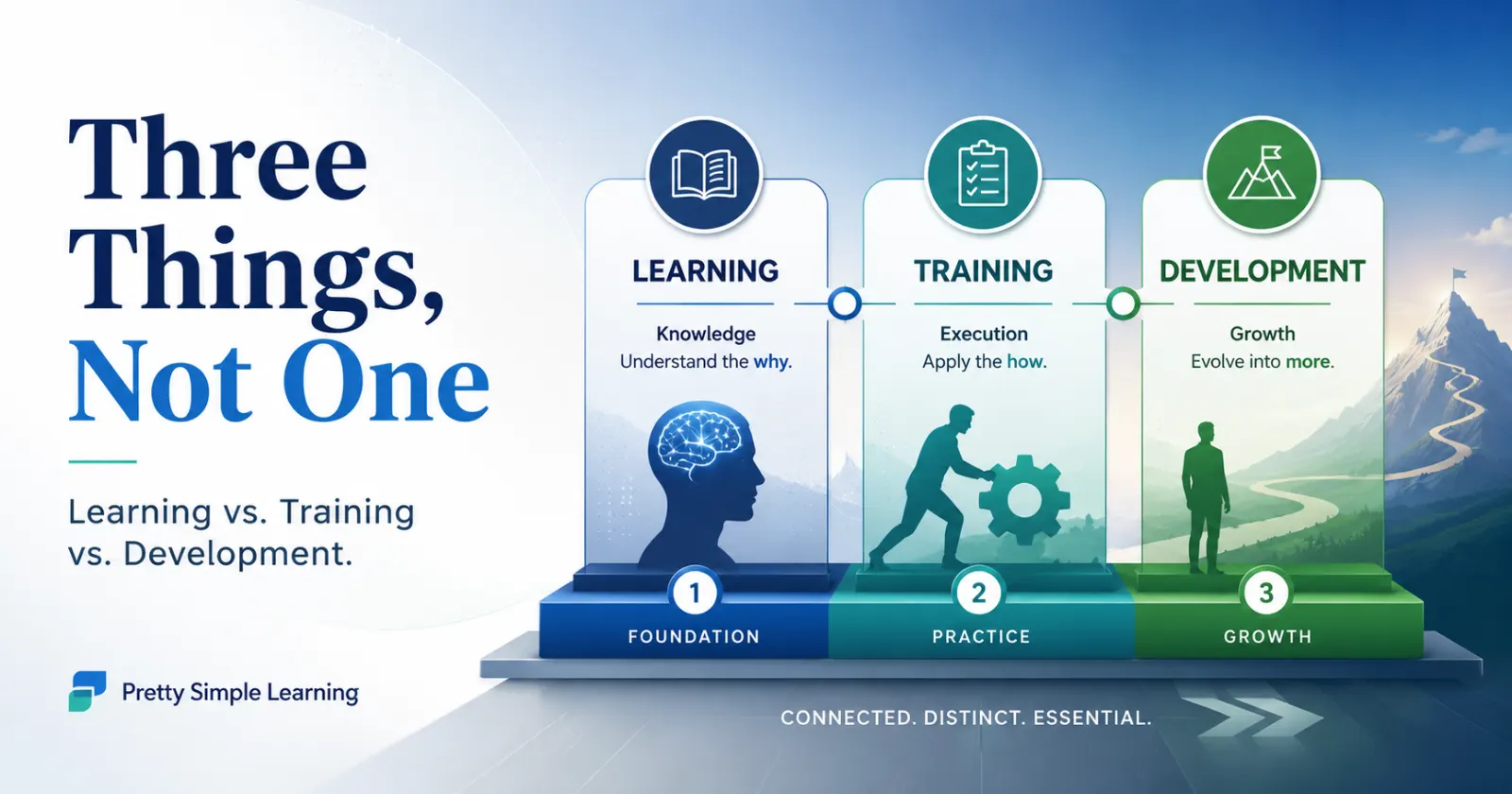
Learning is about acquiring knowledge. Facts, frameworks, definitions, the stuff you can put on a flashcard. A pilot has to know what the takeoff checklist contains. A medical student has to know the major branches of the aorta. Learning is foundational, and it's the thing AI is, frankly, really good at supporting.
Training is about the ability to execute. Demonstrable, observable, measurable against tolerances. A pilot has to fly an instrument approach as charted, navigating to meet specific altitudes, airspeeds, and controller instructions to land at their airport. A new salesperson has to handle an objection without losing the deal. Training assumes some knowledge underneath it and turns that knowledge into capability.
Development is something else entirely. Development is about who someone is — and who they can become. The role they're growing into, the responsibilities they can hold, the judgment they can exercise without supervision. The student pilot becomes a pilot-in-command. The associate becomes a partner. A team lead becomes someone capable of running a division. Development includes learning and training, but neither alone gets you there.
Here's why this matters. When you treat the three as interchangeable, you optimize for the wrong outcomes. You sign people up for "leadership development" programs that turn out to be leadership training — knowledge transfer with a few role-plays bolted on. You measure progress by hours completed and quizzes passed. You confuse a certificate of completion with the actual transition into a role. And then you wonder why the people who finished the program don't behave any differently afterward.
Pretty Simple Learning is built around keeping learning, training, and development distinct.
Courses, lessons, assessments — the things you'd expect from any serious LMS — are vehicles for Learning and Training, and we've built them to be rigorous and straightforward to author. But Development is its own layer, and it doesn't happen by passing a quiz. It happens through scenario-based engagement, iterative feedback, and the kind of instructor-student relationship that lets someone build the confidence to hold a role on their own. Features like Digital Exchange exist for exactly that purpose, and more in that direction is on the roadmap.
This isn't a casual design choice. The approach behind it has a name — Kairos — an architecture, a method, and a definite opinion about where AI helps and where it shouldn't. There's more to say about all of that, and I'll be writing about it in coming posts.
For now: if you've ever felt that the difference between learning, training, and development matters, and that most platforms don't honor it — that's the gap PSL was built to close.