
Don't Invent a Taxonomy. Inherit One.
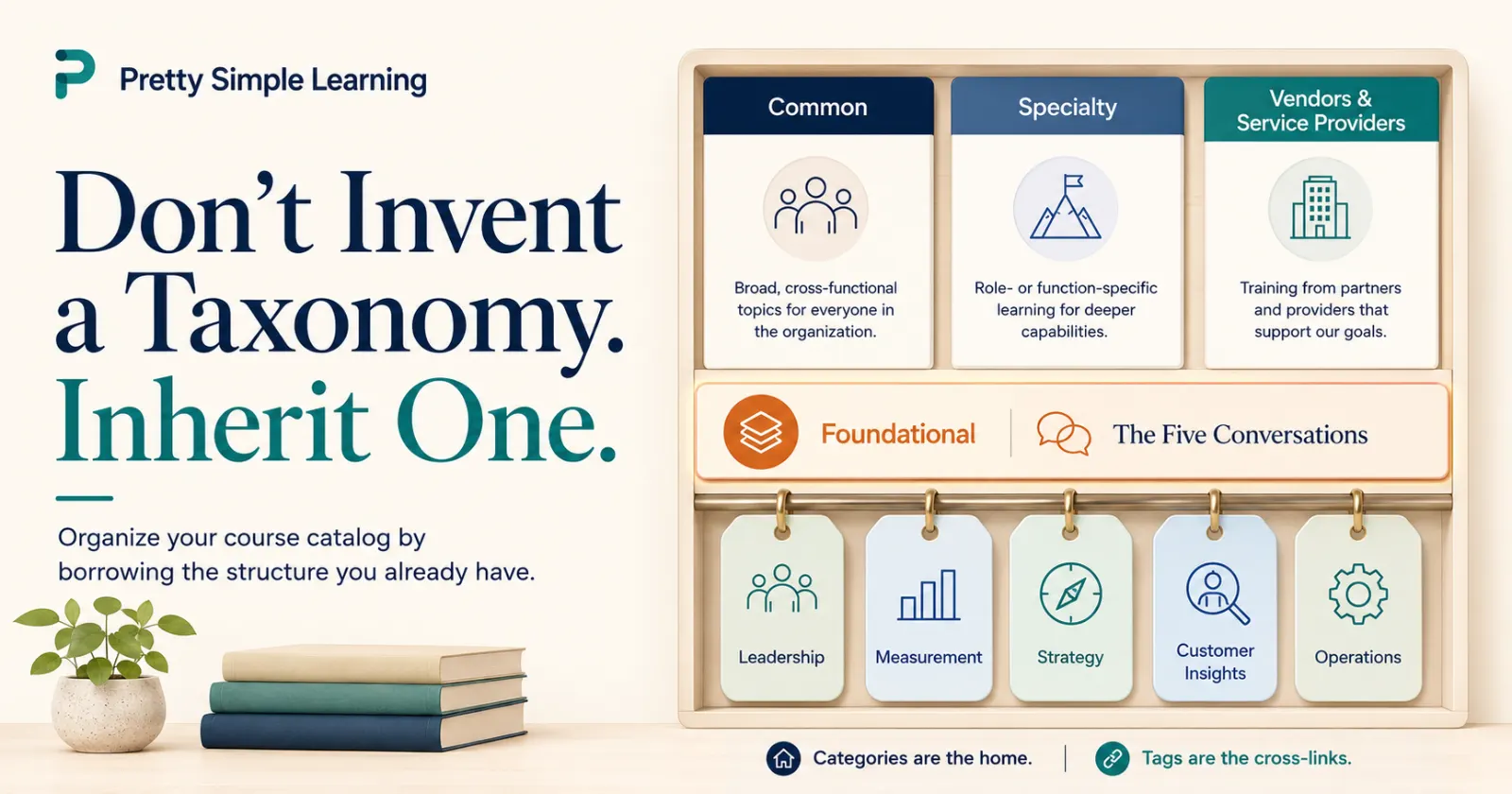
How we organized a growing course catalog without adding a single new idea — and the one small thing we added on purpose.
There's a moment that arrives quietly. You've made a few things — courses, products, articles, offers — and one day there are enough of them that people can't easily find what they need. So you sit down to fix it. Whiteboard, sticky notes, clever buckets. You start designing a way to categorize everything.
It feels like progress. Usually, it isn't.
Most homemade taxonomies are a new layer of complexity laid on top of work that already had a perfectly good structure — you just hadn't noticed it yet. The scheme you invent at the whiteboard competes with the order your work already has, and now your audience has to learn two maps instead of one.
We ran straight into this building Pretty Simple University. Here's what we found, and the two moves that sorted it out.
The structure was already on our own website
PSU is built on Pretty Simple Learning and exists to extend the advisory and analyst work of Pretty Simple Group. So when we needed categories for a growing catalog of courses, the honest question wasn't "what categories should we invent?" It was "how is this work already organized?"
The answer was sitting on our own services page. The advisory practice sorts its work into service areas, grouped three ways: Common, Specialty, and Vendors & Service Providers. Roughly a dozen areas in all. That grouping is the catalog. Each service area becomes a shelf. Each course becomes an offer on a shelf. Nothing to invent.
And it's better than anything we'd have dreamed up, for a reason that's easy to miss: the learner now navigates the same structure a client already navigates. The university isn't a parallel universe with its own logic to learn — it's the same map, gone deeper. Continuity beats cleverness.
The general lesson travels well beyond us. The structure you need is almost always latent in how you already do the work. Your service menu. Your invoice line items. The phases of your process. The way you already describe what you do to a new customer. Before you design a taxonomy, go look for the one you've already been using without naming it.
The one thing we added — and why a method deserves its own shelf
One course refused to sit still: our signature one, The Five Conversations, which is our way of taking an intention and turning it into something real. It touched nearly every service area and belonged cleanly to none. The easy move was to jam it onto the nearest shelf and move on. We didn't.
Instead we added a fourth group the website doesn't have — Foundational — and gave the method its own tier. Because that's the honest description of it. It isn't a service area; it's the approach underneath the service areas. Clients don't buy your method as a line item. It's baked into every engagement, invisible and everywhere at once. But a university gets to make explicit what the practice embodies and never itemizes. That's worth a shelf of its own.
The trick with a tier like this is keeping it from becoming a junk drawer. The rule we hold: Foundational holds only domain-agnostic ways of working — methods that recur across every area — and nothing else. A "basic" technical skill isn't foundational; it has a natural home in a specific area. A way of thinking that shows up no matter what you're working on is. By that test, the next resident almost writes itself: focusing on the vital few. It's not tied to one domain. It's how the work gets approached, full stop.
So: three groups borrowed from the structure we already had, and one added on purpose to name the thing that structure couldn't see.
Where it lives vs. what it's about
A clean category structure has one weakness. It's rigid by design — every course gets exactly one home. But real interests don't respect homes. Someone who cares about measurement wants every course that touches measurement, regardless of which shelf it happens to sit on.
So we added a second, looser layer: tags. A course lives in one category but carries many tags. The two answer different questions:
The category answers where does this live? — one home, the structural truth.
A tag answers what is this about? — many per course, the threads a learner pulls from their own curiosity.
Together they let a person navigate two ways at once: down your shelves, or across them by whatever they happen to care about today.
Here's the move in one example. A customer-satisfaction course lives on the Consumer Insights shelf — that's its home. But it carries a tag that bridges it to service management, so the IT-service-management person finds it through their own interest, without us ever having to shelve the same course in two places. The category tells the truth about where it belongs. The tag builds the bridge.
The discipline that keeps tags from rotting
Tags fail in exactly one way: sprawl. Left to a free-text box, analyst-relations and AR and analyst_relations quietly drift apart until no single tag reliably gathers anything, and the whole layer becomes noise.
The fix is a controlled vocabulary — a short, curated list rather than an open field. The standard each tag has to meet is simple: it must be a real gathering point, something that pulls together more than one thing. Start small. Grow on purpose, one defined tag at a time. Prune at the seams when two tags start meaning the same thing. A tag that only ever fits one course isn't a category of interest yet — it's just a label, and labels don't help anyone find anything.
The pretty simple move
Step back and look at what we actually added. One new idea — Foundational — and one new mechanism — tags. Everything else was already there, sitting in plain sight on a page we'd written long ago.
That's the whole thing in miniature. Complex challenges rarely need complex answers. More often they need you to notice the order that's already present in your work, name it out loud, and put it to use. The clever new scheme you were about to design at the whiteboard is usually a step backward from the structure you've already earned.
So if you're staring at a pile of things you've made, wondering how on earth to organize them — don't start with a blank whiteboard. Start with how you already do the work. The taxonomy you're looking for is probably one you've been using all along. Find it, name it, and get out of the chair and into action.