
AI Makes Learning More Important, Not Less
The age of AI has created an uncomfortable question for anyone who designs, delivers, or sells training:
If AI can answer questions, explain concepts, summarize information, generate examples, and walk someone through a process on demand — why should they take your course?
Does entertaining that question make you feel uneasy?! If it does, you're not alone. It's a fair question, and trainers, educators, consultants, coaches, and subject matter experts need an answer now.
Here's ours: AI doesn't make learning less important. It makes learning more important than ever. But it changes what makes learning valuable.
For decades, people built careers around what they knew. They developed expertise, mastered tools, earned certifications, accumulated experience, and became trusted because they had knowledge others needed. That model is no longer enough.
Knowledge still matters. Expertise still matters. Skill still matters. But none of them is sufficient on its own anymore. When information is easy to access, summarize, and repackage, the advantage of simply knowing more begins to shrink. The question is no longer "What do you know?" but "What can you do with what is known?"
That shift changes the work for individuals, for the organizations they work in, and most of all for the people who design and deliver learning. And the time to respond to it is now.
AI Exposes Weak Learning Design
Much of traditional training rests on a simple premise: people need information, skills, and frameworks to perform well. So our courses and programs focus on content delivery — teach the process, explain the framework, demonstrate the tool, test for understanding, and issue the certificate.
There's still a place for that. People do need to understand systems, methods, standards, and tools. But the model assumes the primary learning problem is a knowledge gap: someone doesn't know something, so we teach it to them.
That made sense when knowledge was scarce, and expertise was hard to find. It's far less complete in a world where AI produces answers, outlines, summaries, drafts, and tutorials in seconds. A participant can ask AI for a definition, a checklist, a comparison, or a template, then follow up with their own questions at their own pace, whenever they need help.
This doesn't make courses obsolete. It makes courses that are only about facts easy to replace. AI doesn't eliminate the need for learning; it exposes the limits of learning that stops at information transfer.
Focus on What Happens After the Answer
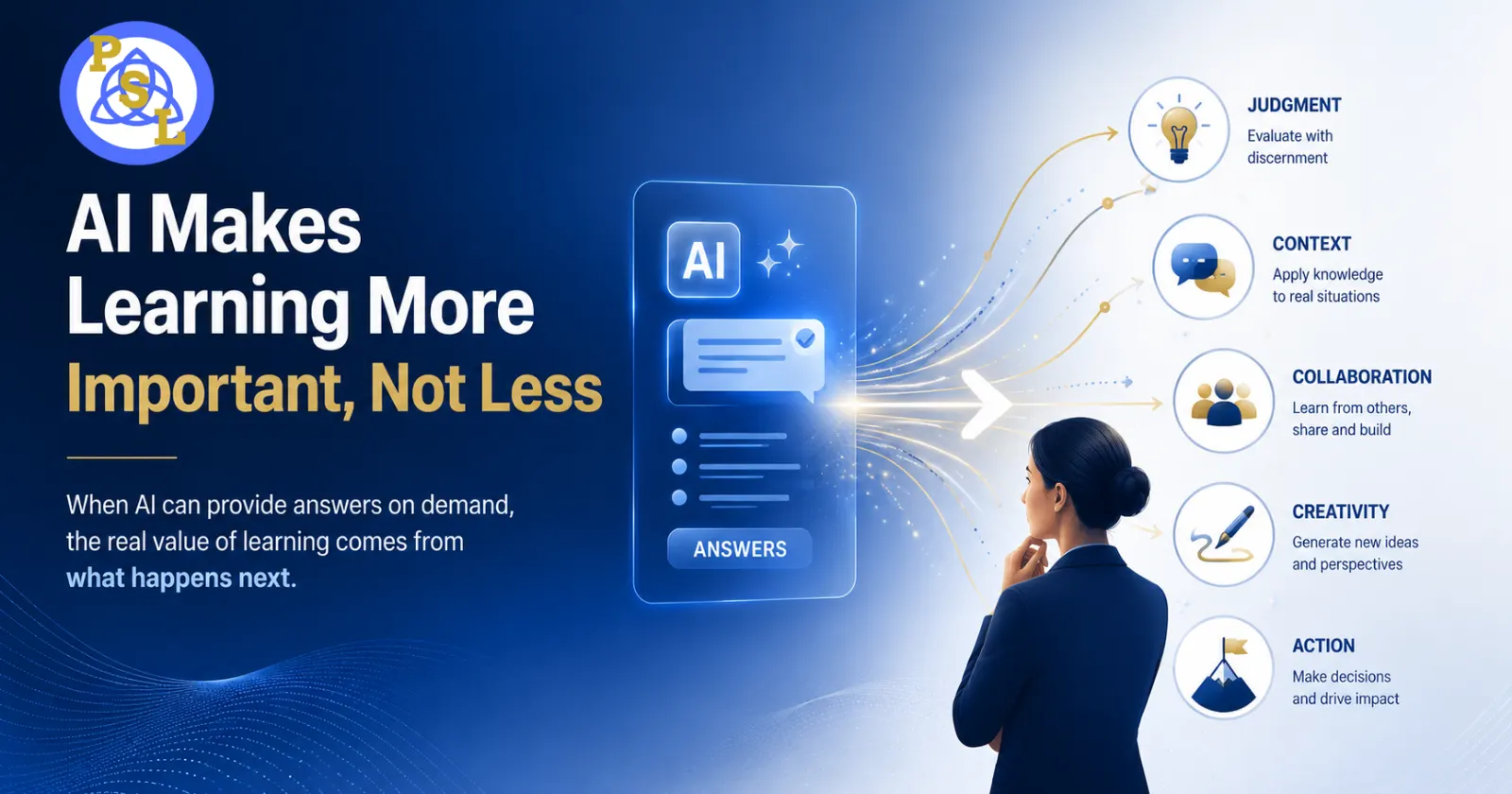
If AI can deliver answers on demand, designers need to shift their focus to what happens next.
The value of learning is no longer in providing access to information. It's in helping people understand what that information means, decide whether it applies, adapt it to their situation, and use it to act well. That's what a well-designed course can still offer that AI alone cannot: structure, context, guided practice, and the chance to surface assumptions, weigh choices, and build judgment.
So course design needs to move — not away from knowledge, but beyond it. Facts, frameworks, and examples still matter, but they should serve a larger purpose: application, reflection, discussion, feedback, and change.
When AI can generate an answer, the learning experience has to help people answer the harder questions:
Is this the right answer for this situation?
What assumptions are built into it?
What could go wrong?
How would I explain it to someone else?
What decision does it support, and what should I do next?
That is the work worth building around now.
The New Human Advantage
AI already helps people draft documents, summarize meetings, generate ideas, compare options, and support decisions. That doesn't mean it's always right, and it doesn't mean your learners need less from you. It means the opposite.
As AI takes over more of the routine production of answers, human value concentrates in the areas AI can't reliably handle on its own: asking better questions, understanding context, challenging assumptions, recognizing weak answers, spotting risk, communicating clearly, navigating ambiguity, building trust, and making ethical decisions. These aren't optional "soft skills." They're the capabilities that make someone worth hiring, promoting, and trusting.
That requires a different kind of learning than most programs deliver. Too much training is still built as an event: work through the module, pass the quiz, collect the certificate. That may satisfy a requirement, but it doesn't prepare anyone to think, decide, and adapt when the work changes.
And the work is changing now. Whatever you train people in, the people you teach are being asked to move faster, exercise more judgment, and fold AI into their work responsibly, often all at once. A tool tutorial isn't enough. A framework overview isn't enough. Your learners don't only need to know how to use AI; they need to learn how to work, think, and contribute in an environment where AI is part of the operating reality.
The Opportunity for Trainers and Subject Matter Experts
This is where the moment turns from threat to opportunity.
The people who design and deliver learning can keep building around the old model: "I have knowledge; I'll transfer it to you"
Or they can help create the next one: "Let's develop the capabilities you need to create value in changing conditions."
That doesn't mean abandoning expertise. It means using it differently. The expert is no longer just a source of information; they become a guide, curator, translator, coach, scenario designer, and facilitator of better thinking. Trainers can design experiences that let people practice judgment, not just recall facts. Consultants can help organizations rethink how they build capability. Coaches can help professionals find where their human strengths matter most. Subject matter experts can turn hard-won experience into learning that helps others adapt, not just comply.
That's powerful territory — and it's open now.
The Time to Act Is Now
AI isn't a future trend waiting politely on the horizon. It's already changing how work gets done, how expertise is applied, and how value is created. Learning, training, and development need to evolve with it.
Don't wait until the people you serve feel the ground shift under them. Don't wait until your current skills feel less valuable or your programs start to look dated. The best time to adapt is before circumstances force the issue.
The future of learning won't be defined by who produces the most content or teaches the most tools. It will be defined by who helps people become more capable, adaptable, thoughtful, and confident in the face of change.
That's why AI makes learning more important, not less. And for trainers, educators, consultants, coaches, and subject matter experts ready to move beyond the traditional, this is the moment to lead.
This is the conviction Pretty Simple Learning is built on: that the point of a course is no longer to hand people information, but to help them do something worthwhile with it. If you're rethinking how you design and deliver your own programs, that's exactly the kind of work we built the platform to support. We'd be glad to have you build it here.